
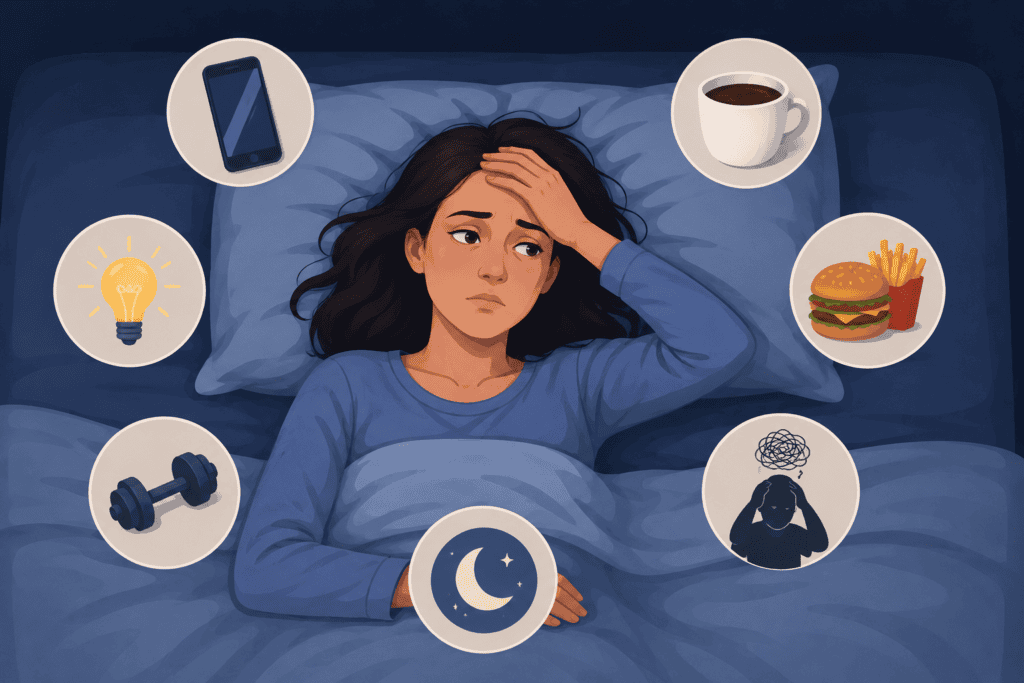
You went to bed at a reasonable hour, slept uninterrupted for a solid eight hours, yet you woke up feeling like you barely slept at all. This frustrating phenomenon highlights a critical medical truth: sleep quantity does not guarantee sleep quality.
When we talk about poor sleep quality, we are looking at the disruption of your brain’s natural night-time repair cycle. If your body cannot transition smoothly through the specific architectural stages of sleep, it cannot perform the essential cellular cleanup, memory consolidation, and metabolic regulation required to help you feel refreshed.
1. Understanding Your Sleep Architecture
Every single night, a healthy brain cycles through two distinct forms of sleep: Non-REM (Rapid Eye Movement) and REM sleep. These cycles occur in waves lasting roughly 90 to 110 minutes each, repeating 4 to 6 times a night.
Stages 1 & 2 (Light Sleep): Your heart rate slows, your body temperature drops, and you transition away from wakefulness. You spend about half your night here.
Stages 3 & 4 (Deep / Slow-Wave Sleep): This is the holy grail of physical restoration. During deep sleep, your body releases human growth hormone, repairs muscles and tissues, strengthens the immune system, and clears cellular waste from the brain. If you are waking up physically sore or sluggish, you are likely being robbed of these specific deep stages.
REM Sleep: This is where active dreaming occurs. Your brain processes emotions, solidifies memories, and synthesizes complex information from the day.
If something constantly fragments these phases—even for a split second that you don’t consciously remember—the entire clock resets, preventing you from spending enough time in deep and REM states.
2. The Silent Saboteurs of Sleep Depth
What exactly ruins this beautiful architecture? It usually comes down to three main environmental and physiological disruptors.
Alcohol and Late-Night Digestion
While a glass of wine might help you fall asleep faster, alcohol is one of the most aggressive anti-REM compounds known to science. As your liver metabolizes the alcohol during the night, it acts as a stimulant, triggering frequent micro-awakenings and completely crushing your REM sleep cycles in the second half of the night. Similarly, eating a heavy dinner right before bed forces your core temperature up as your digestive tract works over-time, blocking the biological cooling needed for deep sleep.
Thermoregulation and Light Pollution
Your brain requires a drop in core body temperature of about 2°F to initiate and stay in deep sleep. Keeping your bedroom too warm (above 70°F or 21°C) directly limits slow-wave sleep. Additionally, ambient light from streetlights or devices penetrates your eyelids, signaling your master biological clock (the suprachiasmatic nucleus) that it is still daytime, suppressing melatonin.
3. Designing a High-Quality Sleep Environment
If you want to transition from simply lying in bed to achieving genuine, restorative neurological recovery, try implementing a highly specific evening routine.
1.Enforce the Food and Drink Cutoff:3 Hours Before Bed.
Eliminate all heavy meals, alcohol, and large amounts of liquids. This allows your digestive system to rest and prevents middle-of-the-night bathroom awakenings.
2.Initiate the Digital Blackout:1 Hour Before Bed.
Turn off bright overhead lights and put away smartphones and tablets. Switch to a book or a relaxing hobby under warm, dim lighting to allow your natural melatonin wave to crest.
3.Optimize the Physical Environment:At Bedtime.
Set your bedroom thermostat between 65°F and 68°F (18°C) and ensure the room is completely dark. The drop in ambient temperature mimics nature, signaling your body to drop into deep, slow-wave restoration.