
For decades, receiving a diagnosis of Type 2 diabetes has been framed in dark, permanent clinical terms: a chronic disease, a progressive failure of the pancreas, and an unavoidable sentence to a lifetime of medical dependence. It is an approach that leaves millions of people feeling broken, anxious, and stripped of personal agency.
But a profound, compassionate shift is happening within the modern medical community. Groundbreaking clinical trials are proving that Type 2 diabetes is not a fixed, mysterious disease that randomly strikes the body. Instead, it is an adaptive, environmental condition—a physiological reflection of a modern lifestyle mismatch.
When you reframe Type 2 diabetes not as an irreversible illness, but as a critical, biological signal that your daily habits need to evolve, everything changes. You step out of the role of a passive patient and into the role of an active metabolic architect.
1. The Survival Overload: What is Actually Happening?
To understand why Type 2 diabetes is a lifestyle condition rather than a standard disease, we have to look at the mechanics of insulin resistance.
Our bodies were beautifully engineered for an ancient world—an environment of physical scarcity, whole natural foods, and constant physical movement. Today, we live in a world of constant nutritional surplus, sitting for hours at desks, and consuming highly processed foods engineered for rapid absorption.
[ Chronic Caloric Surplus ] ──> Liver & Muscle Cells Max Out ──> Ectopic Fat Accumulates ──> Insulin Signaling Fails
When you consistently consume more energy than your muscles can burn off, your body has to figure out where to put the extra fuel. Initially, it stores it safely as subcutaneous fat (under the skin). However, everyone has a unique, genetically determined “personal fat threshold.”
Once your safe fat storage tanks are full, the excess fat begins spilling over into places it should never be—specifically wrapping around your liver and clogging your pancreas. This is known as ectopic fat deposition.
As these vital organs choke on excess fat, their cellular communication breaks down. Your pancreas pumps out insulin, but your overfilled liver and muscle cells literally “lock their doors” to prevent more sugar from entering. This is insulin resistance. Your body isn’t failing; it is actively trying to survive a continuous energetic overload.
2. What the Remission Data Proves
The most compelling proof that Type 2 diabetes is a reversible lifestyle state comes directly from gold-standard clinical trials. For years, the medical community believed that once your blood sugar crossed the diabetic threshold ($A1C \ge 6.5\%$), your pancreatic beta cells were permanently dead. We now know that is false.
The DIRECT Trial Breakthrough: The landmark Diabetes Remission Clinical Trial (DiRECT) published in The Lancet shattered the old chronic disease paradigm. The study showed that through a structured, non-pharmaceutical lifestyle protocol focused on losing weight and clearing organ fat, nearly 86% of individuals who lost 15 kilograms (33 lbs) achieved complete Type 2 diabetes remission. They effectively normalized their blood sugar and stepped off all medications.
The Pancreatic Rebirth: MRI imaging from these trials revealed something miraculous: when individuals shed systemic fat, the toxic fat suffocating the pancreas cleared away. The pancreas naturally changed its shape, woke up, and began producing clean, healthy insulin once again.
The Global Scope: This shift in thinking is critical. According to data from the International Diabetes Federation (IDF), over 500 million people globally live with Type 2 diabetes. Treating this exclusively with medications masks the underlying lifestyle mismatch while the silent root cause remains unaddressed.
3. Shifting from Disease Management to Lifestyle Redesign
If Type 2 diabetes is a lifestyle condition, the solution cannot be found solely in a pharmacy bottle. True resolution requires a systematic remodeling of how you feed, move, and rest your body.
Rebuilding Nutritional Boundaries
You don’t need to starve yourself or completely eliminate joy from your diet. The evolution relies on moving away from ultra-processed foods (UPFs)—packaged goods loaded with refined seed oils, added sugars, and stripped of natural fiber.
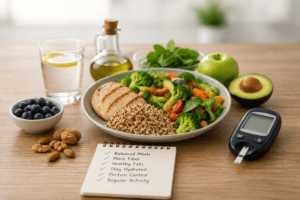
When you pivot your lifestyle toward whole, single-ingredient foods (like leafy greens, lean proteins, avocados, nuts, and legumes), you naturally introduce fiber. Fiber slows down digestion, prevents rapid blood sugar spikes, and gives your body time to burn off energy cleanly without triggering insulin panic.
Converting Muscles into a Glucose Vacuum
Every time you walk, lift an object, or engage your muscles, those muscles pull sugar directly out of your blood stream to use for fuel. They do this completely independent of insulin.
By establishing a lifestyle that incorporates brief physical movement after eating, you effectively turn your muscles into a massive metabolic vacuum cleaner, clearing sugar out of your blood before it can ever accumulate and cause damage.
The 3-Step Lifestyle Calibration Protocol
Transitioning your lifestyle to achieve metabolic health is a progressive journey. Because your body replaces red blood cells roughly every 90 to 120 days, a three-month commitment to these changes will completely rewrite your health profile.
When you sit down for a meal, change the order in which you eat your food. Always eat your fiber (vegetables/salad) and protein (meat, fish, tofu) first, saving any complex carbohydrates for the very end of the meal. Clinical tracking shows this simple mechanical sequencing reduces post-meal glucose spikes by up to 73%.
Commit to a non-negotiable 10-minute walk within 20 minutes of finishing your lunch and dinner. This direct lifestyle adjustment utilizes muscle contraction to capture the incoming digestive sugar spike before it can trigger an aggressive insulin surge.
Enforce a strict sleep schedule aiming for 7 to 8 hours of quality rest. Chronic sleep deprivation elevates your body’s baseline cortisol (stress hormone), which directly signals your liver to dump stored sugar into your blood in the morning, worsening insulin resistance overnight.